
Choosing the best type of inground swimming pool is not simply a contest between concrete, fibreglass and vinyl. The right answer depends on your property, available space, design expectations, maintenance preferences and long-term budget.
For many Dubai villa owners, a concrete pool offers the strongest all-round solution because it allows extensive customisation. However, fibreglass can suit homeowners who value faster installation and simpler maintenance. Vinyl-liner pools may reduce the initial construction cost, but the liner will eventually require replacement.
In other words, every pool type has strengths. None arrives wearing a crown and announcing itself as the universal winner.
This guide compares the main inground pool options and explains which one makes the most sense for different Dubai properties.
What Are the Main Types of Inground Swimming Pools?
The three main construction types are:
- Concrete swimming pools
- Fibreglass swimming pools
- Vinyl-liner swimming pools
The Pool & Hot Tub Alliance recognises concrete, vinyl-liner and fibreglass as established pool-construction categories. Regardless of the material, proper site analysis, engineering, circulation, waterproofing and finishing remain essential to a successful project.
Features such as infinity edges, plunge-pool dimensions and lap-pool layouts describe the design or use of the pool. They do not always describe how contractors construct the shell.
For example, an infinity pool can use a reinforced concrete shell, while a plunge pool may use concrete or a prefabricated fibreglass structure.
Which Is the Best Type of Inground Swimming Pool for Dubai?
For most custom villa projects, a reinforced concrete swimming pool is generally the best overall choice.
Concrete pools can follow almost any practical shape, depth or layout. They work well when the pool must fit an irregular garden, connect with landscaping, include an infinity edge or complement the architecture of a luxury villa.
Concrete also allows contractors to incorporate:
- Sun shelves and shallow lounging areas
- Built-in steps and benches
- Integrated spas
- Infinity or overflow edges
- Waterfalls and decorative walls
- Custom lighting positions
- Unusual depths and dimensions
The National Ready Mixed Concrete Association explains that freshly mixed concrete can be formed into different shapes before it hardens into a strong and durable material. This basic characteristic explains why concrete works well for highly customised structures.
However, “best overall” does not mean “best for everyone.” A standard rectangular fibreglass pool may make more sense when installation speed and lower routine maintenance matter more than complete design freedom.
Concrete Inground Swimming Pools
A concrete pool usually consists of a reinforced structural shell, waterproofing, internal finishes, coping, circulation plumbing and filtration equipment.
Contractors commonly use sprayed concrete methods such as gunite or shotcrete. These terms describe how the concrete mixture reaches the pool shell. For most homeowners, the quality of engineering, application, curing and waterproofing matters more than winning an argument over terminology.
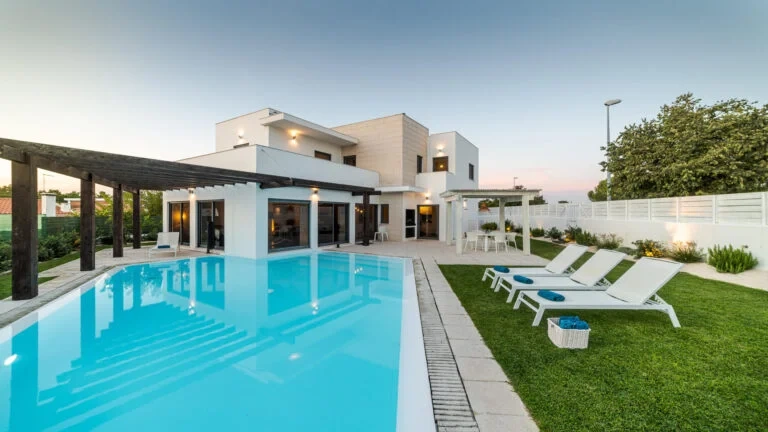
Advantages of Concrete Pools
Concrete provides the highest level of design flexibility among the major inground pool types. Industry comparisons consistently identify customisation as one of its main advantages.
A concrete pool may be suitable when you want:
- A pool designed around a specific villa layout
- A large or unusually shaped structure
- A deep section or dedicated lap lane
- An infinity edge
- Premium tile or mosaic finishes
- Integrated seating or spa features
- A pool that coordinates with a wider outdoor renovation
Concrete construction also allows the pool design to respond to existing walls, trees, pathways and entertainment areas instead of forcing the entire garden to accommodate a prefabricated shell.
Disadvantages of Concrete Pools
Concrete pools usually require more time to design and construct. Excavation, steel reinforcement, concrete application, curing, waterproofing, tiling and system testing all form part of the process.
They can also cost more than standard fibreglass or vinyl alternatives. Interior finishes may eventually require repair or renewal, while rough or damaged surfaces can make cleaning more difficult.
Concrete is durable, but it is not magical. Poor waterproofing, weak construction joints or rushed curing can still create problems. A strong material cannot rescue weak workmanship any more than an expensive oven can rescue someone who burns toast.
Fibreglass Inground Swimming Pools
A fibreglass pool uses a manufactured shell that arrives at the property as a finished or nearly finished unit. The contractor excavates the site, prepares the base, positions the shell and connects the pool systems.
Advantages of Fibreglass Pools
Fibreglass pools can offer a shorter on-site installation period because the manufacturer produces the shell off-site.
Their smooth internal surfaces can also make routine cleaning easier. Compared with many concrete finishes, the surface has fewer pores and rough areas where dirt and organic material can collect.
Fibreglass can work well for homeowners who want:
- A standard pool shape
- A relatively quick installation
- A smooth internal finish
- Less surface maintenance
- Predictable design options
- A compact family or plunge pool
Disadvantages of Fibreglass Pools
The main limitation involves design freedom. Buyers must choose from shapes and sizes available from the manufacturer.
Delivery access also matters. The contractor must transport the shell to the property and position it inside the excavated area. Narrow villa entrances, boundary walls, mature landscaping or limited crane access may complicate installation.
Repairs and refinishing also require specialist knowledge. Homeowners should confirm local product support, warranties and replacement options before choosing a shell.
A catalogue image may look perfect, but the delivery vehicle still needs to reach the garden. Sadly, fibreglass pools have not yet learned to fold themselves through a side gate.
Vinyl-Liner Inground Swimming Pools
A vinyl-liner pool uses a structural wall system covered by a flexible waterproof liner. Contractors can create different shapes, although the available system and liner design affect the final result.
Advantages of Vinyl-Liner Pools
Vinyl pools often carry a lower initial cost than highly customised concrete pools. The liner creates a smooth surface and comes in various colours and patterns.
Vinyl may suit a homeowner who wants:
- A lower initial construction budget
- A smooth surface
- A relatively simple pool layout
- More shape flexibility than some fibreglass shells
- The option to refresh the appearance by changing the liner
Disadvantages of Vinyl-Liner Pools
The liner does not last indefinitely. Manufacturer comparisons commonly state that liners need periodic replacement, although the actual interval depends on material quality, chemical balance, use and maintenance.
Sharp objects, careless cleaning equipment and damaged fittings can puncture the liner. Poor water chemistry can also shorten its useful life.
Dubai homeowners should confirm whether their shortlisted contractor has reliable access to replacement liners, matching fittings and specialist technicians. A lower starting price becomes less attractive when replacement support proves difficult to find.
Inground Swimming Pool Comparison
| Factor | Concrete Pool | Fibreglass Pool | Vinyl-Liner Pool |
| Customisation | Excellent | Limited to available shells | Good |
| Installation speed | Usually slowest | Usually fastest on site | Moderate |
| Initial cost | Usually highest | Mid-range to premium | Often lower |
| Surface | Tiles, plaster or coatings | Smooth manufactured finish | Smooth flexible liner |
| Maintenance | Finish needs long-term care | Generally simpler surface care | Liner needs careful treatment |
| Complex designs | Excellent | Limited | Moderate |
| Infinity edge suitability | Excellent | Limited by system | Less common |
| Future resurfacing | May require refinishing | Specialist repair may apply | Liner replacement required |
| Best suited to | Custom and luxury villas | Standard family pools | Budget-conscious projects |
This table gives a general comparison. Final performance depends heavily on engineering, product quality, installation and ongoing maintenance.
How Much Do Different Inground Pools Cost in Dubai?
There is no reliable fixed price for every pool. Size is only one part of the quotation.
Parallax’s guide to the construction cost of a swimming pool in Dubai gives an approximate 2026 range of AED 50,000 to AED 80,000 for a compact or plunge pool. A standard family pool may range from approximately AED 80,000 to AED 150,000, while larger custom pools can cost considerably more.
Final pricing depends on:
- Pool size and depth
- Excavation and soil conditions
- Structural design
- Shell material
- Waterproofing
- Tiles or internal finishes
- Filtration and circulation equipment
- Heating or cooling systems
- Lighting and automation
- Infinity edges or water features
- Landscaping and decking
- Access limitations
- Consultant, developer and authority requirements
These ranges are planning estimates, not guaranteed prices. A contractor should inspect the property and prepare a written scope before confirming the cost.
How to Choose the Best Type of Inground Swimming Pool
Choose Concrete When Customisation Matters Most
Concrete makes sense when the pool must fit a particular architectural plan or include premium features. It is usually the strongest option for infinity pools, complex shapes, integrated spas and major villa outdoor projects.
Choose Fibreglass When Speed and Simplicity Matter
Fibreglass suits homeowners who like an available shell design and want to reduce the amount of construction completed at the property.
Before proceeding, confirm delivery access, shell dimensions, warranty terms and local repair support.
Choose Vinyl When Initial Budget Is the Main Priority
A vinyl-liner system may reduce the upfront investment. However, include eventual liner replacement in your long-term planning.
Do not compare only the first invoice. The cheapest pool on opening day may not remain the cheapest over years of ownership.
Does the Pool Type Affect Maintenance?
Yes, but every swimming pool requires regular water testing, filtration, cleaning and equipment checks.
The US Centers for Disease Control and Prevention states that chlorine and pH form the first line of defence against germs in residential pools. It recommends routine testing and keeping pH between 7.0 and 7.8.
Concrete surfaces may require brushing and eventual refinishing. Fibreglass has a smooth surface but still needs correct water chemistry. Vinyl liners need gentle cleaning and protection from punctures.
Pool material changes the maintenance process; it does not remove it. Anyone promising a “maintenance-free pool” may also have a bridge to sell.
Do You Need Approval for an Inground Pool in Dubai?
Dubai Municipality provides a dedicated service for the approval of private and public swimming-pool drawings. The authority states that approval helps ensure compliance with technical, engineering and safety standards before construction begins.
Depending on the property, you may also need permission or a no-objection certificate from the master developer or community management authority.
Ask your contractor or consultant to confirm:
- The authority responsible for the property
- Required drawings and calculations
- Developer NOC requirements
- Submission responsibilities
- Inspection stages
- Completion documentation
Never begin excavation based only on a verbal “it should be fine.” Swimming pools are excellent places for water, but poor places for regulatory surprises.
Inground Swimming Pool Trends for Dubai Villas in 2026
Dubai homeowners increasingly want pools that improve the entire outdoor space rather than dominate it.
Practical design directions include compact plunge pools, shallow lounging shelves, integrated seating, clean rectangular layouts, concealed overflow systems and coordinated poolside landscaping.
Energy-conscious owners also look beyond the shell. Efficiently sized pumps, automation, pool covers and well-planned circulation can affect long-term operation. Equipment should match the pool’s actual volume and hydraulic requirements rather than relying on the theory that a larger motor must automatically be better.
A professional landscaping company in Dubai can coordinate planting, drainage, paving and privacy around the pool. A nearby pergola can also create a shaded seating area without blocking the main swimming zone.
Common Mistakes to Avoid
Villa owners often focus heavily on the pool shape while giving too little attention to filtration, drainage and maintenance access.
Other common mistakes include:
- Choosing a material before completing the site survey
- Ignoring crane or delivery access for fibreglass shells
- Selecting equipment without hydraulic calculations
- Starting work before obtaining approvals
- Comparing quotations with different specifications
- Forgetting future resurfacing or liner replacement
- Placing trees too close to the pool
- Reducing the equipment-room size excessively
- Choosing finishes based only on showroom lighting
The best pool is not simply the one with the most dramatic image. It is the one that works properly after the photographer leaves.
Final Verdict
For most Dubai villa owners seeking a customised, permanent and premium pool, concrete is the best type of inground swimming pool. It provides the greatest freedom in shape, depth, finishes and integrated features.
Fibreglass is often the better choice for a standard layout when quick installation and a smooth, lower-maintenance surface take priority. Vinyl-liner pools may suit tighter initial budgets, provided the owner plans for future liner replacement.
Before making the final decision, arrange a site assessment with experienced swimming pool contractors in Dubai. Parallax Technical Services LLC can evaluate your villa layout, preferred design, construction requirements and wider outdoor plans before recommending a suitable pool system.
Frequently Asked Questions
Which type of inground pool lasts the longest?
A properly designed and maintained concrete pool can remain in service for many years, although its internal finish may eventually need renewal. Fibreglass shells can also provide long service when installed correctly. Pool life depends on engineering, groundwater conditions, material quality, water chemistry and maintenance—not the shell material alone.
Is a concrete or fibreglass pool better?
Concrete is better for custom shapes, unusual depths, infinity edges and integrated luxury features. Fibreglass is better when you prefer an available shell design, quicker on-site installation and a smooth surface. The right choice depends on your site access, design goals and long-term maintenance preferences.
What is the easiest inground pool to maintain?
Fibreglass pools generally have one of the easiest surfaces to clean because the manufactured finish is smooth. However, the filtration system, surrounding landscaping and water chemistry also affect maintenance. Even the smoothest pool will develop problems when owners ignore cleaning and chemical balance.
Are vinyl-liner pools suitable for Dubai?
Vinyl-liner pools can work in Dubai when qualified contractors install and maintain the system. Before choosing one, check the liner specification, warranty, replacement cost and local availability of technicians. Strong sunlight, water chemistry and physical damage can affect liner life.
Can I build an infinity pool with fibreglass?
Some specialist fibreglass systems may support overflow features, but concrete generally offers greater freedom for custom infinity-edge designs. Infinity pools need careful hydraulic and structural planning, including a collection channel or balance tank. The visual edge may appear effortless, but the engineering certainly is not.
What is the best inground pool for a small garden?
A compact concrete plunge pool provides strong design flexibility for a narrow or irregular garden. A small fibreglass shell can also work when access and available dimensions allow it. Focus on usable seating, circulation space and shade rather than squeezing in the largest possible pool.
How do I select a swimming pool contractor?
Review relevant completed projects, confirm trade licensing, request a detailed scope and ask who handles approvals. The quotation should identify the shell, waterproofing, filtration, finishes, lighting and exclusions. Avoid choosing a contractor only because they supplied the shortest quotation or the most enthusiastic salesperson.
