
Choosing the right type of pool for your backyard starts with one question that homeowners often skip: what will you actually use the pool for?
A family that wants weekend swimming and children’s play needs something different from a homeowner who wants morning laps. Someone with a compact villa garden may get more enjoyment from a plunge pool than from a large pool that swallows almost every square metre of outdoor space.
For Dubai homeowners, the decision should also consider site access, maintenance, shade, landscaping and approval requirements. A pool may look simple when finished, but underneath those attractive tiles sit structural, waterproofing, plumbing, filtration and electrical systems.
The goal, therefore, is not to choose the biggest or most fashionable pool. It is to choose the pool that makes your backyard work better.
What Is the Best Type of Pool for a Backyard?
There is no single best pool for every home. A family pool works well for recreation and everyday use. A plunge pool makes sense for compact gardens and relaxation. A lap pool suits homeowners who mainly swim for exercise, while an infinity pool works best when the architecture, elevation or view gives the disappearing-edge effect a genuine purpose.
Construction method matters too. The Pool & Hot Tub Alliance identifies concrete, fibreglass and vinyl-liner pools as established pool categories, each with different strengths in customisation, installation and maintenance. Your first decision should therefore be about use. Material comes next.
Start With How Your Family Will Use the Pool
Before discussing tiles, lights or waterfalls, write down your three main reasons for building a pool.
Do you want somewhere for children to swim? A place for exercise? A relaxing outdoor feature? A pool for parties and entertaining? Or simply somewhere to cool down during Dubai’s warmer months?
This exercise helps prevent an easy mistake: designing around impressive photographs instead of daily life.
If swimming forms only one part of your outdoor plans, a smaller pool can preserve room for a pergola, dining area, lawn or landscaped seating.
Sometimes less water creates a better backyard.
Types of Backyard Swimming Pools
Family Swimming Pool
A family swimming pool should focus on usability rather than complicated shapes. Comfortable entry steps, usable swimming space, and clearly planned shallow areas can make the pool easier for different family members to enjoy. Surrounding circulation also matters because people still need somewhere to sit, walk and relax.
Avoid making the pool so large that every garden chair ends up pressed against a boundary wall.
Plunge Pool
A plunge pool works particularly well where outdoor space is limited. It provides an area for cooling, relaxing and casual swimming while leaving more space for planting, decking or shaded seating. A compact pool can still feel premium when the contractor coordinates its finish, lighting and landscaping with the villa.
For townhouses or smaller villa gardens, this can be a much more logical solution than squeezing in a full-size pool.
Lap Pool
Choose a lap pool if swimming for exercise genuinely forms part of your routine. The long, narrow layout can work along a side garden or rectangular plot. However, the design still needs adequate space around the pool for circulation, cleaning and maintenance.
Be realistic about how you will use it. A 15-metre fitness pool sounds impressive. If your real exercise programme involves floating quietly with coffee nearby, another layout may serve you better.
Infinity or Overflow Pool
Infinity pools allow water to flow over one or more edges, producing a visually seamless effect.
They make the most sense where a villa has an attractive view, elevated plot or architectural layout that supports the effect. Because the overflow system requires additional hydraulic and structural planning, homeowners should choose it for a reason rather than simply because it looks luxurious.
A disappearing edge facing a plain boundary wall rather defeats the disappearing-edge drama.
Concrete vs Fibreglass vs Vinyl: Which Should You Choose?
Pool style describes how you use or experience the pool. Construction material describes how contractors build it.
Concrete Swimming Pools
Concrete generally provides the greatest design freedom.
Contractors can create custom dimensions, depths, steps, benches, curves and other features. That flexibility makes concrete particularly suitable for irregular villa gardens, luxury projects and pools that need to coordinate precisely with existing architecture.
Parallax’s swimming pool contractors in Dubai provide custom pool design, structural construction, waterproofing, circulation systems and finishing as part of the complete construction process.
Concrete construction, however, involves more stages than installing a prefabricated shell, so owners should expect a more involved project.
Fibreglass Swimming Pools
Fibreglass pools arrive as factory-manufactured shells. The compromise is design flexibility. Homeowners choose from available shell shapes and sizes instead of creating almost any configuration from scratch.
Access matters too. The contractor must physically transport and position the shell at your property. A beautiful fibreglass pool cannot politely squeeze itself through a narrow villa gate.
Vinyl-Liner Pools
Vinyl-liner pools use a structural frame with a flexible liner forming the internal waterproof surface.
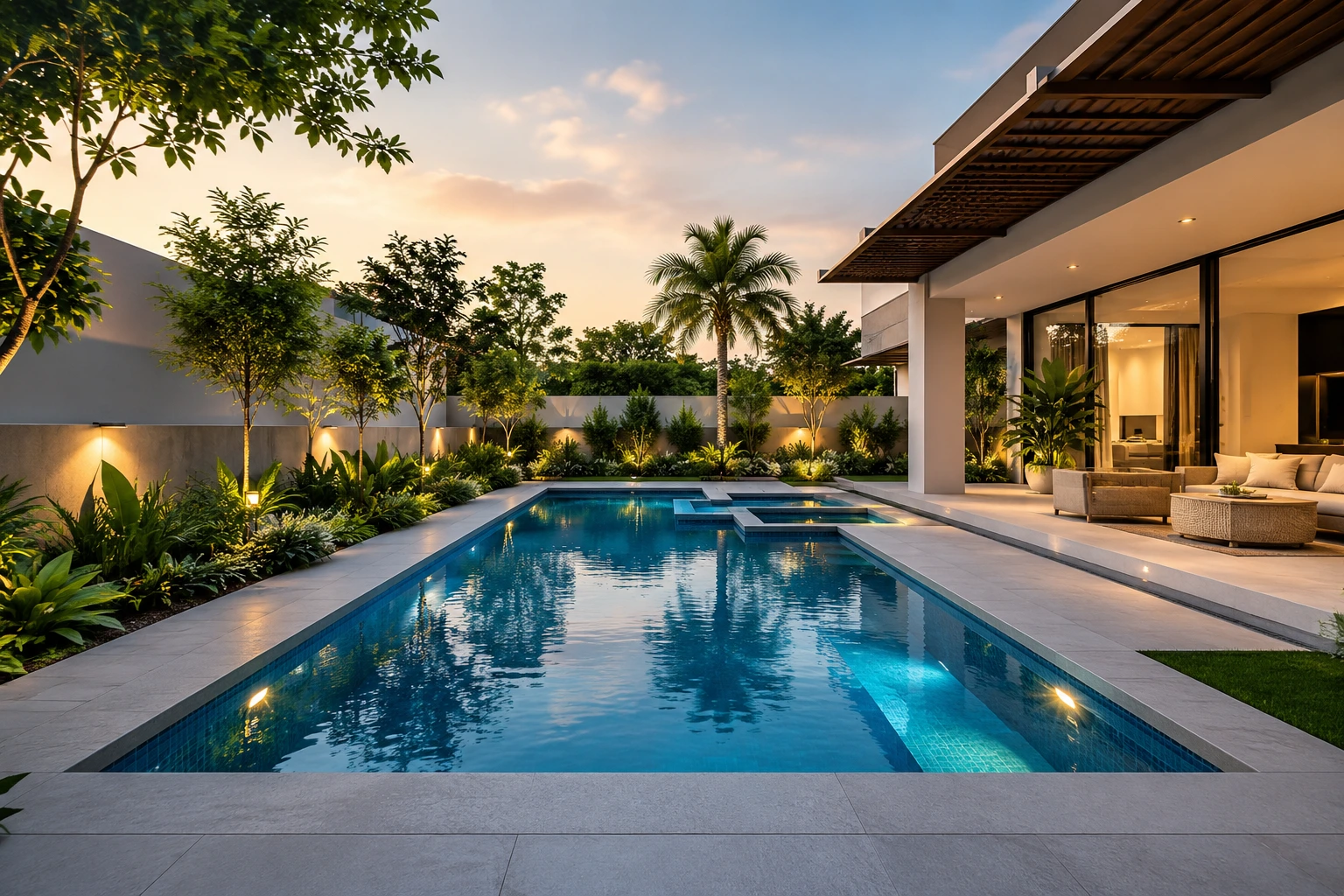
They can offer design versatility and a different initial cost profile from fully customised concrete pools. However, the liner remains a replaceable component, so homeowners should consider long-term replacement and local servicing when comparing options.
For Dubai projects, ask contractors about product availability, replacement support and suitability for the proposed site before choosing this system.
Measure the Whole Backyard, Not Just the Pool Area
A pool must fit around the rest of your outdoor life.
Before finalising dimensions, identify:
- Villa doors and windows
- Boundary walls
- Existing trees and planting
- Irrigation systems
- Drainage
- Outdoor seating
- Pergolas
- Barbecue or outdoor kitchen areas
- Pool equipment space
- Excavation and construction access
Then think about movement.
Can someone walk comfortably from the villa to the garden while others sit beside the pool? Can technicians reach the pump and filtration equipment without dismantling half the patio? Is there enough usable space when nobody is swimming?
These questions are not exciting enough for Instagram, but they matter for years after construction.
Plan the Pool and Landscaping Together
A pool should feel connected to its surroundings.
Paving, planting, lighting, shade and privacy can dramatically change how comfortable the area feels. Parallax already treats pool construction as part of wider outdoor planning and can integrate projects with a landscaping company in Dubai and pergola construction.
Think carefully about trees as well. Plants can add privacy and soften hard pool finishes, but poorly positioned vegetation may create extra debris or restrict access.
A smaller, balanced pool with good landscaping can often create a more luxurious backyard than a huge pool surrounded by leftover paving.
Think About Pool Maintenance Before You Build
Every swimming pool requires ongoing water treatment, filtration and cleaning.
The US Centers for Disease Control and Prevention explains that maintaining appropriate chlorine levels and pH helps control germs in residential pools. The CDC recommends maintaining pool pH between 7.0 and 7.8 and routinely testing pool water.
Maintenance requirements extend beyond water chemistry.
Think about:
- Access to filters and pumps
- Ease of cleaning pool edges
- Number of steps and ledges
- Surrounding trees
- Water features
- Pool covers
- Interior finish
Complex designs can look excellent, but every additional corner, shelf and decorative feature becomes another surface that needs attention.
The perfect low-maintenance pool does not exist. If someone invents one, pool owners everywhere will probably send them flowers.
Do You Need Approval for a Backyard Pool in Dubai?
Do not begin excavation before checking the requirements for your property.
Dubai Municipality currently publishes separate technical guidance covering private swimming pool safety and approval of swimming pool plans.
Properties within other jurisdictions may follow additional procedures. Dubai Development Authority, for example, maintains construction permit and building-modification services for developments under its authority.
Your requirements can therefore depend on the location, property, community, master developer and scope of work.
Before signing the construction contract, establish who will handle:
- Technical drawings
- Authority submissions
- Developer NOCs where applicable
- Structural requirements
- Inspections
- Completion documentation
Current authority guidance should always take priority over what someone remembers from another villa project several years ago.
Never Ignore Pool Safety
Safety should influence the layout from the beginning, particularly in homes with children. Dubai Municipality publishes dedicated private swimming pool safety guidance. Internationally, the US Consumer Product Safety Commission also recommends layers of protection against unsupervised child access, including appropriate barriers, while stressing that barriers do not replace adult supervision.
Discuss safe entry, slip resistance, visibility, access control and suitable poolside circulation during design rather than trying to solve these issues after construction. Good safety usually looks better when it was planned from day one.
Consider the Whole Project Budget
The price of a swimming pool involves more than the visible shell. Your project may include excavation, reinforcement, waterproofing, plumbing, filtration, tiles, coping, lighting, electrical work, decking, equipment, landscaping, and approval-related work.
Pool dimensions, depth, site access, soil conditions and premium features can also change the scope. Parallax’s existing swimming pool construction cost in Dubai guide explains the major factors behind local construction pricing. When comparing contractors, do not simply ask which quotation costs less.
Ask what each quotation actually includes.
Two quotes cannot be compared fairly if one includes filtration, lighting and finishing while another leaves those items for an interesting financial surprise later.
Questions to Ask Your Swimming Pool Contractor
Before choosing a contractor, ask:
- Which pool type suits this backyard and why?
- Which construction method do you recommend?
- What exactly does your quotation include?
- Which items are excluded?
- Who handles drawings and approvals?
- How will you waterproof the pool?
- Which filtration system will you install?
- Where will the equipment area sit?
- How will you manage surrounding drainage?
- What ongoing maintenance will the pool require?
An experienced contractor should explain the advantages and limitations of different options.
Be cautious when every conversation somehow ends with the most expensive solution being “the only sensible choice.”
Common Mistakes to Avoid
One of the biggest mistakes involves choosing the pool before planning the backyard. Also avoid selecting a pool that overwhelms the available space, ignoring maintenance access, choosing finishes entirely by appearance, adding features you will rarely use and starting construction before confirming approvals.
Another common mistake involves planning landscaping after the pool has already occupied all the useful space.Think about water, shade, seating, planting and movement as one outdoor environment.
Final Thoughts:
How you plan to use your pool will determine the type of pool that is best for your backyard. Choose a family-sized pool for versatility in everyday life, a small plunge pool if space is an issue, a lap swimming pool if exercise is important, or an infinite pool based on the architecture of your home and its view.
Choose the construction method based on the site, the design and the maintenance requirements. Concrete allows for extensive customisation while fibreglass offers a prefabricated option with different installation benefits.
Parallax Technical Services LLC will assess the outdoor space and pool requirements, as well as the surrounding landscape, before offering a solution. Call, WhatsApp, or use the website form to contact the team.
FAQs
What is the best type of pool for a backyard with a limited space?
In a small yard, a plunge pool is ideally suited because it offers shady space to cool down and relax without taking up the whole garden. Compact concrete pools can be used in narrow or irregular spaces. Avoid choosing the largest size possible for the pool, but instead, allow enough space to maintain the pool, seat the guests and drain it.
What is better for the backyard, a fibreglass or concrete pool?
Concrete allows for greater flexibility in terms of shape, depth, integrated features and steps. Fibreglass is a shell that has been manufactured in a factory, which can reduce the time required for construction on site. It is not a matter of one material being superior to another, but rather your design needs, access to the site, shell dimensions available, maintenance preferences, and budget.
What size backyard pool should I have?
The size of the pool is not the same for all villas. You should consider how many people you will be using the pool, whether it is for exercise or relaxation, and how much room must remain to accommodate seating, pathways, shading, and landscaping. First, measure the entire area. It is often better to have a smaller, well-proportioned pool than a large pool that makes the rest of your backyard hard to use.
What type of pool is the easiest to maintain for a backyard?
No swimming pool is completely maintenance-free. Upkeep is also affected by filtration, water chemistry and the complexity of design. Regardless of construction material, pool owners must monitor water quality. The CDC recommends that residential pools be tested regularly for pH and chlorine levels.
Do I require approval to build a pool in my Dubai villa?
The approval requirements vary depending on the project, location, authority responsible, community, and scope of work. Dubai Municipality has published technical guidelines for swimming pool plans and private pool safety, while other authorities follow their own construction process. Before excavation begins, ask your contractor or consultant about the current approvals and NOC requirements.
Do I start with the pool or the landscaping?
Plan them both together. The position of the pool affects pathways, privacy, drainage and shade, as well as seating and planting. Landscaping has an impact on how comfortable and easy it is to maintain your pool. By coordinating both during the design phase, you can preserve valuable outdoor space while creating a backyard with a sense of purpose. This is better than adding landscaping to the gaps left by the pool construction.
